
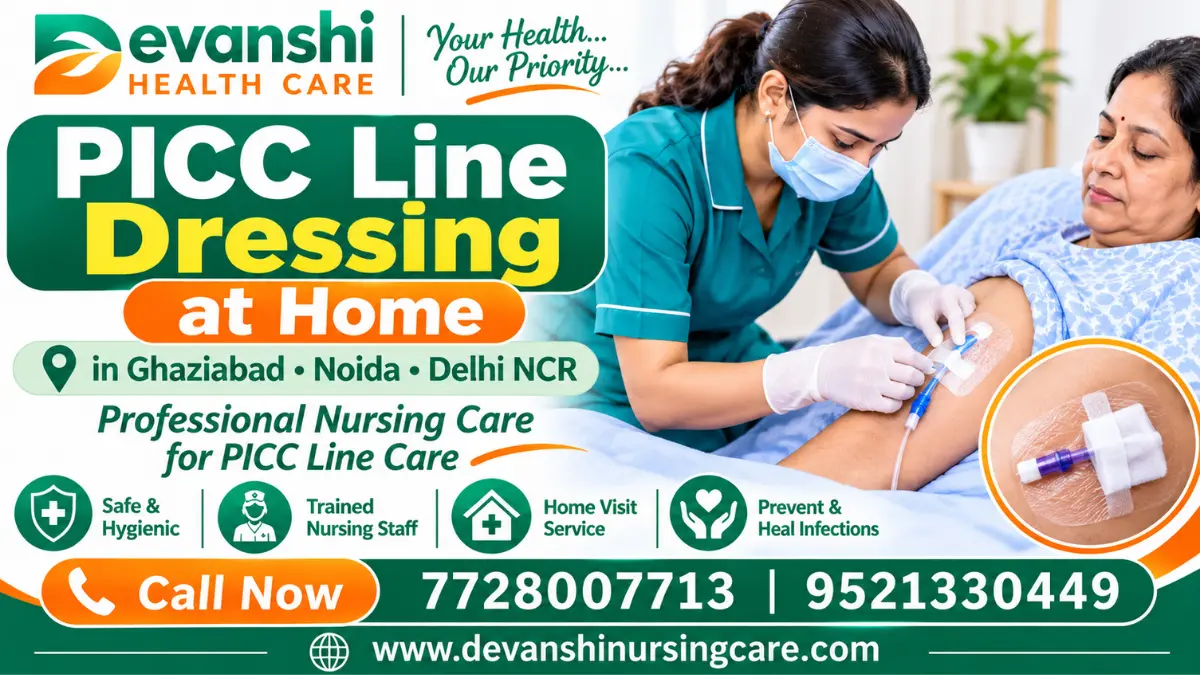
PICC Line Dressing at Home in Ghaziabad, Noida & Delhi NCR – Professional Nursing Care by Devanshi Nursing Care
Patients receiving long-term intravenous treatment may require a special type of vascular access called a PICC line. A PICC line, or peripherally inserted central catheter, is a thin, flexible tube inserted into a vein in the upper arm and advanced until its tip reaches a large vein near the heart. It allows prescribed medicines, fluids, and certain treatments to be administered over an extended period.
Proper PICC line care is important to help reduce the risk of infection, catheter displacement and other complications. Regular dressing changes, inspection of the insertion site, and maintenance of a clean, secure dressing are essential parts of the care plan.
For patients who have difficulty travelling to a hospital or clinic, PICC line dressing at home may be a convenient option when approved by the treating doctor. Devanshi Nursing Care provides home healthcare and nursing support enquiries in Ghaziabad, Noida and Delhi NCR, subject to clinical suitability and professional availability.
For PICC line dressing assistance, contact Devanshi Nursing Care at 7728007713 or 9521330449.
What Is a PICC Line?
A PICC line is a long, thin catheter inserted through a vein in the upper arm. It is used when a patient needs repeated or long-term intravenous access.
Doctors may recommend a PICC line for certain treatments that require regular administration of medicines or fluids. It can reduce the need for repeated needle insertion into smaller peripheral veins.
A PICC line may be used for:
Prescribed intravenous antibiotics.
Certain chemotherapy treatments.
Long-term intravenous medication.
Specific IV fluids and nutritional support.
Other treatments requiring reliable vascular access.
The type of treatment and duration of PICC line use are decided by the treating medical team.
What Is PICC Line Dressing?
PICC line dressing is the process of replacing the protective dressing covering the catheter insertion site on the upper arm. The dressing helps protect the insertion area and keeps the catheter secure.
The procedure must follow the hospital's PICC line care protocol and the treating team's instructions. It generally involves removing the old dressing carefully, inspecting the insertion site, cleaning the area using an approved antiseptic, allowing it to dry and applying a new sterile dressing.
PICC line dressing is different from an ordinary wound dressing because the catheter enters a central vein. Strict aseptic technique and appropriate training are essential.
Why Is PICC Line Dressing Important?
A PICC line provides access to the bloodstream, so poor catheter care can lead to serious complications. Regular dressing maintenance helps protect the insertion site and allows early recognition of problems.
Important reasons for PICC line dressing include:
1. Reducing infection risk: Appropriate skin antisepsis and sterile dressing techniques help reduce contamination around the catheter insertion site.
2. Protecting the insertion site: A suitable dressing covers the area and protects it from external contamination.
3. Keeping the catheter secure: Correct dressing application helps prevent accidental pulling or movement of the catheter.
4. Monitoring the skin: Dressing changes provide an opportunity to observe redness, swelling, tenderness, or discharge.
5. Maintaining catheter care standards: Following the prescribed dressing schedule helps maintain consistent care.
A dressing should also be changed if it becomes wet, loose, visibly soiled, or compromised, according to the care protocol.
Benefits of PICC Line Dressing at Home in Ghaziabad, Noida & Delhi NCR
Patients receiving long-term treatment may need repeated PICC line dressing visits. Travelling to a healthcare facility can be tiring for elderly patients, people recovering after surgery, and individuals with limited mobility.
When the treating medical team confirms that home dressing is suitable, home nursing support may offer several benefits:
Convenience: Patients may receive routine dressing support without travelling to a hospital.
Comfort: Care takes place in a familiar home environment.
Regular maintenance: Scheduled dressing changes can be arranged according to the prescribed care plan.
Professional assistance: A trained and authorised healthcare professional can follow appropriate catheter-care protocols.
Family guidance: Carers can learn how to protect the catheter between dressing visits.
Reduced travel burden: Suitable patients may find it easier to continue their prescribed treatment routine.
Home dressing is not a replacement for hospital assessment when a catheter-related complication is suspected.
What Is Included in a PICC Line Dressing Procedure?
The exact procedure should follow the treating hospital's protocol, the catheter manufacturer's instructions and the patient's care plan. A qualified professional trained in PICC line care may perform the following steps.
1. Reviewing the Patient's Care Instructions
The professional reviews the available catheter information, dressing schedule, relevant medical instructions, and any known allergies, particularly allergies to antiseptics, dressings, or adhesive materials.
2. Preparing a Clean Working Area
The required supplies are prepared before the procedure. These may include appropriate sterile dressing materials, gloves, antiseptic solution, a securement device, and other items specified by the care protocol.
3. Performing Hand Hygiene
Hand hygiene is performed before handling the catheter or dressing. Appropriate aseptic precautions are maintained throughout the procedure.
4. Removing the Existing Dressing
The old dressing is removed carefully to avoid pulling or displacing the PICC line. The catheter should remain stabilised during the process.
5. Inspecting the Insertion Site
The insertion area and surrounding skin are checked for redness, swelling, pain, discharge, bleeding, or other unusual changes. The external catheter length may be checked against the documented baseline according to the clinical protocol.
Any suspected displacement or complication should be reported to the treating medical team.
6. Cleaning the Insertion Site
The skin is cleaned using the antiseptic and technique specified by the relevant PICC line protocol. The area is allowed to dry completely before a new dressing is applied.
7. Applying a New Sterile Dressing
A suitable sterile transparent or other prescribed dressing is applied. The catheter is secured using the recommended device and method to reduce unnecessary movement.
8. Documenting the Procedure
The dressing date, site condition, and any concerns are documented according to the care plan. Problems requiring medical review are communicated to the treating team.
Important: PICC line flushing, cap changes, blood sampling, and other catheter maintenance procedures are separate tasks. They should only be performed when prescribed and by appropriately trained and authorised professionals. They should not be assumed to be included in a routine dressing visit.
How Often Should PICC Line Dressing Be Changed?
The dressing schedule depends on the dressing product, catheter type, hospital protocol, and the patient's clinical condition.
For example, transparent semipermeable dressings are commonly changed at intervals specified by the clinical protocol, while gauze dressings may require more frequent changes. The dressing must also be replaced sooner if it becomes wet, loose, visibly soiled, or damaged.
Patients should follow the schedule provided by their treating hospital or vascular access team rather than changing the dressing independently.
Important Precautions for PICC Line Care at Home
PICC line care requires careful handling. Patients and carers should follow these precautions:
Keep the dressing clean, dry, and securely attached.
Avoid touching the insertion site or catheter unnecessarily.
Do not pull, twist, or reposition the catheter.
Do not remove the dressing without appropriate instructions.
Avoid soaking the arm or dressing in water.
Follow the prescribed instructions for bathing and protecting the site.
Do not apply creams, oils, or powders around the insertion site unless advised.
Avoid activities that may pull or damage the catheter.
Keep the catheter protected during daily activities.
Attend scheduled follow-up appointments.
Contact the treating team if the dressing becomes wet, loose, or damaged.
Never attempt to push a catheter back into the vein if it appears to have moved.
Warning Signs of PICC Line Infection or Complications
Patients and carers should observe the PICC line site regularly. Contact the treating healthcare team promptly if you notice:
Redness or warmth around the insertion site.
Swelling or increasing pain in the arm.
Pus or unusual discharge.
Bleeding around the catheter site.
Fever or chills.
Leakage from the catheter or dressing area.
A cracked, damaged, or leaking catheter.
A change in the external catheter length.
Difficulty flushing the catheter, if flushing is part of the prescribed care.
Seek urgent medical assessment if the patient develops a fever with chills, sudden shortness of breath, chest pain, fainting, tingling, or severe arm swelling. These symptoms may indicate a serious complication.
If catheter displacement or damage is suspected, do not use the PICC line until the treating team has assessed it.
Who May Need PICC Line Dressing at Home?
Home PICC line dressing may be considered for patients who have an established PICC line and need regular dressing maintenance under medical supervision.
These may include:
Patients receiving prescribed long-term IV antibiotics.
Certain cancer patients receiving treatment through a PICC line.
Patients recovering after major surgery.
People requiring repeated IV medication.
Patients with limited mobility.
Elderly patients receiving long-term treatment.
Patients whose doctors have approved home-based catheter care.
The suitability of home care depends on the patient's condition, catheter status, and availability of an appropriately trained professional.
PICC Line Dressing at Home in Ghaziabad
Patients and families in Ghaziabad can contact Devanshi Nursing Care to enquire about home healthcare support for PICC line dressing. Share the catheter details, dressing instructions, and the treating hospital's care plan when making an enquiry.
Home visits are subject to the availability of an appropriately trained professional and clinical suitability.
PICC Line Dressing at Home in Noida
For patients living in Noida, home PICC line dressing may help reduce the inconvenience of travelling for routine catheter maintenance when home care is approved by the treating medical team.
Families should provide information about the catheter, the last dressing date, any symptoms,s and the prescribed dressing schedule before arranging care.
PICC Line Dressing Services in Delhi NCR
Devanshi Nursing Care receives enquiries for home healthcare and nursing support across Delhi NCR, including Ghaziabad and Noida.
The availability of PICC line dressing support depends on the patient's location, clinical requirements, ts and availability of an appropriately trained and authorized professional.
Why Contact Devanshi Nursing Care?
PICC line care requires attention to hygiene, catheter security,ity and early recognition of complications. Devanshi Nursing Care aims to assist patients and families with home healthcare enquiries and appropriate nursing support.
When contacting the team, keep the following details ready:
Patient's location.
Reason for PICC line placement.
Date of the last dressing change.
Type of dressing currently used.
Treating hospital's dressing instructions.
Any redness, swelling, pain, or discharge.
Relevant allergies or other medical concerns.
This information can help clarify the patient's requirements and whether a home visit may be appropriate.
Book PICC Line Dressing at Home in Ghaziabad, Noida & Delhi NCR
If you or your family member has a PICC line and requires routine dressing support, contact Devanshi Nursing Care to discuss the patient's care requirements.
Devanshi Nursing Care
Contact Numbers: 7728007713, 9521330449
Website: https://devanshinursingcare.com/
Blog: https://devanshinursingcare.com/blog/
Proper PICC line dressing, catheter protection,ction and regular observation are important parts of safe vascular access care. Always follow the treating hospital's instructions and seek prompt medical attention if infection, displacement, or another catheter-related complication is suspected.
Recent Posts
- Bed Sore Care at Home in Ghaziabad, Noida & Delhi NCR
- IV Injection at Home in Ghaziabad, Noida & Delhi NCR
- Wound Dressing at Home in Ghaziabad, Noida & Delhi NCR
- IV Fluid Administration at Home in Ghaziabad, Noida & Delhi NCR
- Ryle’s Tube Insertion at Home in Ghaziabad, Noida & Delhi NCR
- IV Drip at Home in Ghaziabad, Noida & Delhi NCR
- Enema Care at Home in Ghaziabad, Noida & Delhi NCR
- Cannula Insertion at Home in Ghaziabad, Noida & Delhi NCR
- Antibiotic Infusion at Home in Ghaziabad, Noida & Delhi NCR
- Wound Dressing Service at Home in Ghaziabad, Noida & Delhi NCR
- Home Injection Service in Ghaziabad, Noida & Delhi NCR
- Home Dressing Service in Ghaziabad, Noida & Delhi NCR
- Urine Catheter Change at Home in Ghaziabad, Noida & Delhi NCR
- Ryle’s Tube Change at Home in Ghaziabad, Noida & Delhi NCR
- Wheelchair on Rent and Sale in Delhi NCR
- Oxygen Cylinder on Rent and Sale in Delhi NCR
- Suction Machine on Rent in Delhi NCR
- Recliner Bed on Rent in Delhi NCR: 3000/Month
- Hospital Bed for Rent in Ghaziabad, Delhi NCR
Recent Comments
No comments to show.